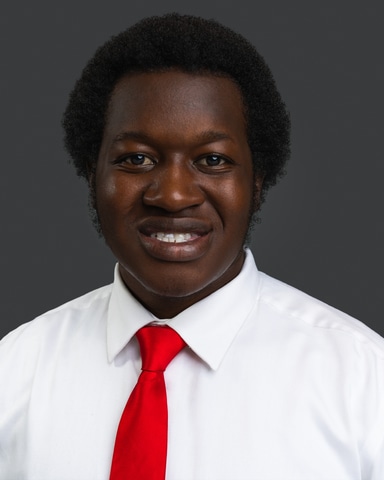
Mware portrait
👋

Data Analyst | Machine Learning | Generative AI

Nickmoon (Moon) Mware

Data professional with a background in machine learning and academia, focused on transforming complex datasets into meaningful insights through Analytics, Natural Language Processing, Predictive Modeling, and Generative AI workflows.

About

I'm Nickmoon Mware, a data and AI-focused technologist with a background in computer science, analytics, and applied research. I earned my B.S. in Computer Science from Benedict College and my master's in Computer Science from the University of Nebraska-Lincoln. I am currently pursuing an M.S. in Information Systems & Business Analytics at Park University, where I'm sharpening the business analytics and decision-support skills that support analyst, BI, and applied ML roles.

My graduate research centered on natural language processing and voice user interfaces, with a particular interest in how accents affect speech-driven systems and user experience.

Today, I'm focused on machine learning, generative AI, and data analytics, using data to uncover patterns, build useful models, and communicate findings clearly for both technical and non-technical audiences.

Portfolio & presentations

Selected case studies, reports, and dashboards across machine learning, analytics, NLP, and generative AI, presented with the business question, approach, and takeaway in one place.

Featured case study

Customer Prediction Models for an eBook Store

Built regression and classification models on 16,519 customer records to predict monthly spend and subscription likelihood for an eBook store.

View analysis PDF

Context

Framed as a customer analytics case study for an eBook store, focused on helping non-technical stakeholders understand who is most likely to subscribe and spend more.

Key insight

The strongest value comes from turning model output into targeting decisions, not just reporting accuracy scores in isolation.

Business impact

Built customer spend and subscription models using PyCaret and gradient boosting so marketing and sales teams could prioritize higher-propensity customer segments with more confidence.

Problem

The business needed a clearer way to identify customers likely to subscribe and estimate monthly value before spending budget on broad outreach.

Methods

Prepared customer features, compared multiple regression and classification approaches, and selected models that balanced predictive performance with stakeholder interpretability.

Findings

The final workflow highlighted which customers were more likely to subscribe and spend more, giving the team a more targeted lens for campaign planning and customer prioritization.

  • Python
  • PyCaret
  • LightGBM
  • Gradient Boosting
  • Feature Engineering

Educational Chatbot Learning Assistant

Conversational AI focused on educational support. I leveraged my experience as an adjunct instructor and the IEEE educational chatbot reference to design intelligent learning assistants that bridge the gap between pedadogy and technology.

View IEEE abstract

Context

Conceptual and research-backed educational AI project shaped by teaching experience, chatbot design thinking, and current work in applied analytics.

Key insight

The most effective learning assistants do more than answer questions. They support comprehension, reduce friction for students, and align responses with instructional goals.

Business impact

Designed an educational chatbot concept using instructional context and NLP framing so student support could become more scalable, consistent, and accessible outside normal class time.

  • Chatbots
  • NLP
  • Educational AI
  • Learning Assistant
Featured case study

Voice User Interface Accent Research

Graduate NLP and speech research on automatic speech recognition, focused on translating spoken audio to text while improving inclusivity for speakers with different accents.

Read research paper

Problem

ASR systems often struggle with speaker variability, producing higher transcription error rates for different accents and speaking styles.

Methods

Processed WAV audio from Wikimedia Commons, generated mel spectrograms, trained a CNN-based speech workflow with Python libraries such as Librosa, NumPy, and PyTorch, and evaluated performance using WER.

Findings

The trained model improved transcription accuracy from roughly 27% to about 77%, while the paper outlines future work on accent robustness, MFCC features, and broader speech datasets.

  • Python
  • Librosa
  • PyTorch
  • Speech-to-Text
  • CTC
  • ASR

Education & Healthcare Analytics

Built Python and SQL analysis workflows on education and healthcare data, including exploratory analysis of a healthcare readmission dataset with 12,980 observations and 28 variables.

Open healthcare EDA PDF

Context

Exploratory healthcare analytics project on a readmission dataset that hiring managers will immediately recognize.

Key insight

This project is strongest when it shows the full workflow: profiling, missing data treatment, feature behavior, and a clear next modeling step.

Business impact

Analyzed readmission patterns and data quality issues so the dataset could support more reliable risk modeling and operational decision-making in a healthcare context.

  • Python
  • SQL
  • EDA
  • Data Cleaning
  • Stakeholder Reporting

Interactive Tableau Dashboards

Designed dashboards to visualize trends, predictions, comparisons, and KPI-style summaries so non-technical audiences could interpret model outputs quickly.

View Tableau Public profile

Context

Public dashboard work intended for recruiters, hiring managers, and non-technical stakeholders reviewing projects.

Key insight

Each dashboard should communicate the business question, dataset context, and primary takeaway within the first few seconds.

Business impact

Built story-first dashboards in Tableau so viewers could move from chart reading to decision insight quickly, without needing a live walkthrough.

  • Tableau
  • Dashboards
  • KPIs
  • Data Visualization

Certifications

IBM

Generative AI for Data Scientists

Covers practical applications of generative AI in data science workflows, including analysis support, experimentation, and model-assisted productivity.

View credential

Dallas Data Science Academy

Generative AI for End-to-End Data Science Modeling

Focuses on integrating generative AI into the full data science lifecycle, from problem framing and analysis to modeling and communication.

View credential

Coursera

Business Intelligence

Supports dashboard design, business-facing communication, and the ability to connect analytical outputs to decision-making contexts.

View credential

LinkedIn Learning

SQL Essential Training

Reinforces practical SQL querying skills used across exploration, reporting, and data validation workflows.

View credential

Insights

Generative AI

Educational Chatbots as Learning Assistants

A future-facing note on how conversational AI can support student learning, course assistance, and engagement when paired with strong UX and domain grounding.

Read more

NLP Research

What I Learned From Building an ASR Research Workflow

A reflection on dataset limits, WER evaluation, spectrogram-based training, and how speech research connects to fairness and usability in voice interfaces.

Read more

Machine Learning

What Prediction Models Reveal About Customer Behavior

A practical look at how feature engineering, model selection, and business framing turn customer data into usable decisions for targeting and planning.

Read more

Analytics

What Exploratory Analysis Reveals in Healthcare Readmission Data

A quick-study view of how profiling distributions, imbalance, costs, visits, and chronic-condition signals helps prepare healthcare data for downstream modeling.

Read more

Core tools

Tools and methods I use across analytics, machine learning, NLP, visualization, and production-ready data workflows.

Education & experience

Contact

I'm open to data analytics, machine learning, NLP, and generative AI opportunities. Reach me directly at nickmoonmware@gmail.com or send a message below.